
The safe road system
The New Zealand government released its Safer Journeys – Road Safety Strategy in March 2010. Safer Journeys is a national strategy to guide improvements in road safety over the period 2010-2020.
It addresses many of the actions called for in the Decade of Action for Road Safety campaign.
The strategy sets out a long-term vision for New Zealand of 'a safe road system increasingly free of death and serious injury'. To support the vision, Safer Journeys introduced, for the first time in New Zealand, the world-leading Safe System approach to improving road safety.
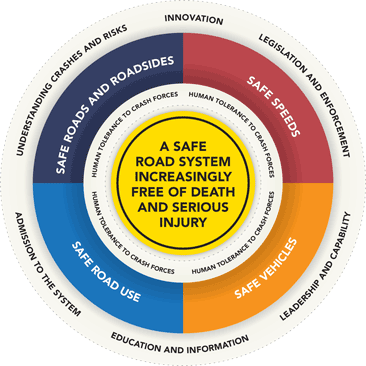
A Safe System approach represents a fundamental shift in the way New Zealanders think about road safety and is based on the four principles below. The big idea is to create a more forgiving road system that reduces the price we pay for human error.
Human beings make mistakes and crashes are inevitable
However, the current consequences of those mistakes and crashes are not acceptable. A Safe System aims to reduce the likelihood of crashes with a focus on removing the potential for death or serious injury.
The human body has a limited ability to withstand crash forces
A Safe System aims to manage the magnitude of crash forces on the human body to remove the potential for death or serious injury.
System designers and road users must all share responsibility for managing crash forces to levels that don't result in death or serious injury
The aim of all system designers working together is to deliver a road transport system that is forgiving of mistakes. System designers include planners, engineers, policy makers, educators, enforcement officers, vehicle importers, suppliers, utility providers, insurers, etc.
It will take a whole-of-system approach to implement the Safe System in New Zealand
All parts of the system need to be strengthened: safe roads and roadsides, safe speeds, safe vehicles and safe road use.
In a truly Safe System we will not accept death or serious injury as inevitable. We will view every crash as a system failure and every casualty as preventable. The four key elements of the system will be able to be described as follows:
SAFE ROADS AND ROADSIDES are predictable (self-explaining) and forgiving of mistakes – their design should encourage appropriate road user behaviour and speeds
SAFE SPEEDS suit the function and level of in-built safety of the road – road users understand and comply with speed limits and drive to the conditions
SAFE VEHICLES help prevent crashes and protect road users from crash forces that cause death and serious injury
SAFE ROAD USE ensures road users are skilled, competent, alert and unimpaired, and people comply with road rules, choose safer vehicles, take steps to improve safety and demand safety improvements
Related Links
What do drivers think about road engineering?